2025 0324 199
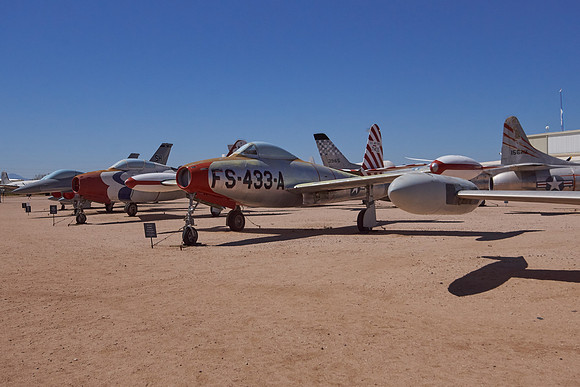
Republic F-84C Thunderjet
The F-84 is Republic’s entry into America’s first generation of jet fighters. It was designed in 1944 in response to an Army Air Force request for a 600-mile per hour fighter and was seen as the successor to the P-47 Thunderbolt. The first prototype flew in February 1946. The second prototype set an American speed record later that year. Several versions of the F-84 were built, some with very significant differences including; straight and swept wings, different engine air intakes, and several engine versions. The F-84 saw extensive use as a fighter-bomber during the Korean War. The F-84C closely resembled the earlier versions with a straight wing but used a slightly improved engine that allowed a heavier weight. A total of 191 F-84Cs were built.
Wingspan36 ft 5 in.
Length37 ft 5 in.
Height12 ft 10 in.
Weight23,347 lbs (loaded)
Maximum Speed587 MPH
Service Ceiling45,000 ft
Range1,282 miles
EngineOne Allison J35-A-13C turbojet with 4,000 pounds of thrust
Crew1
ManufacturerRepublic
Markings33rd Fighter Group, Walker AFB, New Mexico, 1948
Serial Number47-1433
DesignationF-84C
https://pimaair.org/museum-aircraft/republic-f-84c/
Republic F-84F Thunderstreak
The F-84 is Republic’s entry into America’s first generation of jet fighters. It was designed in 1944 in response to an Army Air Force request for a 600 mile per hour fighter. The first prototype flew in February 1946. The second prototype set an American speed record later that year. All versions of the F-84 except for the F-84F had straight wings. The F model, influenced by the success of the F-86, had a swept wing that greatly improved speed and performance. The F-84 saw combat in the Korean War.
Serving mainly as fighter-bombers, a role for which it proved to be superbly suited. During the mid-1950s the U.S. Air Force decided that they needed an aerobatic display team to match the Navy’s Blue Angels and formed the Thunderbirds to display the latest