2025 0324 198
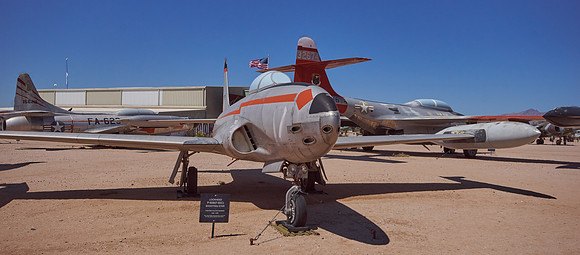
Lockheed P-80B (F-80C) Shooting Star
Designed in 1943 and first flown in 1944 the P-80 became the first mass produced jet fighter in the inventory of the U.S. Air Force. Originally intended as a pure fighter the Shooting Star saw most of its service as a ground support aircraft. However, an F-80 was the victor in the world’s first jet on jet dogfight when one shot down a North Korean MiG-15 in November 1950. F-80s served in training and Air National Guard units until the late 1950s when the last were finally retired. A total of 1,731 F-80s were built.
Wingspan39ft 11 in.
Length34 ft 6 in.
Height11 ft 4 in.
Weight16,856 lbs (loaded)
Maximum Speed580 MPH
Service Ceiling42,750ft
Range1,380 miles
EngineOne Allison J33-A-35 turbojet with 4,600 pounds of thrust
Crew1
ManufacturerLockheed
Markings22nd Fighter Bomber Squadron, 36th Fighter Group, Furstenfeldbruck Air Base, Germany, 1949
Serial Number45-8612
DesignationP-80B
https://pimaair.org/museum-aircraft/lockheed-p-80c/
behind:
Lockheed F-94C Starfire
The U.S. Air Force recognized in the late 1940s that it suffered from a serious lack of a modern all-weather jet interceptor to combat the threat of Soviet bombers. The search for a quick solution to the problem led to the development of the F-86D, F-102A, and the F-94. The Starfire is a highly modified development of the T-33 trainer, incorporating radar and guns. The first F-94 flew in late 1949 and large-scale deliveries to the Air Force began the next year. The F-94C version was the result of further modification of the design and featured a new wing and armament consisting entirely of unguided 2.75-inch Mighty Mouse air-to-air rockets housed in the nose and in two wing mounted pods.
Wingspan42 ft 5 in.
Length44 ft 6 in.
Height14 ft 11 in.
Weight24,200 lbs (loaded)
Maximum Speed585 MPH
Service Ceiling51,400 ft
Range1,200 miles
EngineOne Pratt & Whitney J48-P-5 turbojet with 8,750 pounds of thrust
Crew2
ManufacturerLockheed
Markings