2025 0820 063a
Connecting Goods
With a short north-south railroad line: in the area, North Dakota farmers and agricultural industries could send their products out to connecting transcontinental lines. Coming into the state from the east and west were coal, gasoline, fuel oil, and construction materials.
In the early years, freight was overwhelmingly coal and wheat. Later, gasoline became a third important commodity, coming from nearby oil fields in Kansas, Oklahoma, Texas, and Louisiana to Edgeley on the Milwaukee Road, carried by the Midland Continental Railroad from Edgeley to Wimbledon, and then delivered to the Soo Line and on to Canada.
By the early 1940s, grain elevators at Wimbledon and Frazier accounted for 70 percent of the durum, Flax, and barley shipped on the Midland Continental Railroad. In the railroad's last two decades, freight going through the Wimbledon depot provided over half of the Midland Continental Railroad's revenues.
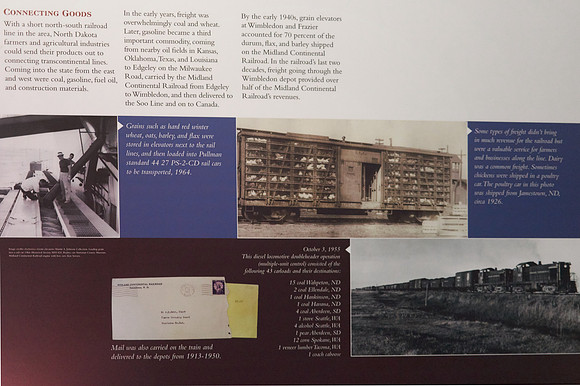
Grain, such as hard red winter wheat, oats, barley, and flax were stored in elevators next to the rail, lines, and then loaded onto Pullman standard 44 27 PS–2–CD rail cars to be transported, 1964.
Mail was also carried on the train and delivered to the depots from 1913-1950.
Some types of freight didn't bring much revenue for the railroad, but we're a valuable service for farmers and businesses along the line. Teri was a common freight. Sometimes chickens were shipped to a poultry car. The poultry car in this photo was shipped from Jamestown, North Dakota, Circa 1926.
October 3, 1953 this diesel locomotive (double-decker operation, multiple-unit count) consisted of the following 43 carloads in their destinations: 13 Wahpeton, 2 coal Ellendale, 1 coal Hankinson, 1 coal Havana, for coal Aberdeen, 1 coal Seattle WA, 1 rair, Aberdeen, 12 corn Spokane WA, 1 lumber Tacoma WA, one caboose.