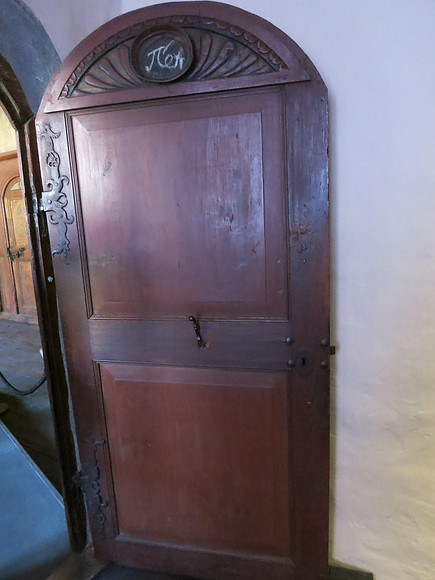
IMG_6224
Wooden doors in Lutherhaus Wittenberg, DE.
The present Luther House was built from 1504 to 1507 for Augustinian hermits. Since 1508 Martin Luther lived and worked and after her marriage in 1525 also Katharina in this estate. The heirs sold the house in 1564 to the Wittenberg University. After 1816, the evangelical seminary used the building. In 1834, a wheelchair-free school was set up on the ground floor. Since 1883, the Lutherhaus Museum.
The basis of today's museum collection was the "Luther Memories Collection" of the Halberstadt Oberdompredigers Ch. Fr. B. Augustin, donated by the Prussian crown to the Lutherhaus in 1860. It comprised about 12,500 pieces: prints, graphics, paintings and coins and medals.
In 1877, a public appeal was made in order to get prominent objects in view of the planned creation of the museum on the occasion of Luther's 400th birthday in 1883. Thus, in 1882, a large part of the library (3027 volumes) was purchased by the founder of the Weimar Lutheran edition, J.K. Fr. Knaakes.
With the inauguration of the conservator Julius Jordan in 1912 then began a systematic processing and expansion of the collection holdings. At the beginning of the 1930s, finally, a part of the Princely Stolberg-Wernigerode collection came to the Luther House.
During the Second World War, the collections had to be outsourced, unfortunately they did not completely return to the museum. During the GDR era only very few pieces could be acquired.
It was only after 1990 that a continuous collection activity began, especially of objects for the newly designed permanent exhibition.