2025 0322 058
Mandrill
Mandrillus sphinx
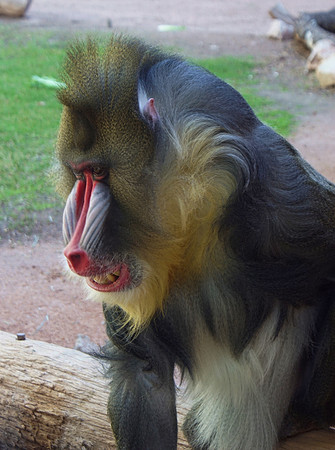
It’s hard to look at mandrills without noticing the bright colors on their faces and rear ends, especially the boys. When males win fights and make their way up the social ladder, their bodies produce more testosterone, which makes the red parts of their skin brighter. They even lose hair on their rumps to show off all that color! Female mandrills are usually less colorful but can have faces ranging from black to bright pink. Scientists are still a little fuzzy on how and why the colors vary in females, but like with the boys, hormones are probably the culprit.
Mandrills can communicate in a variety of ways, including using body language, vocalizations and even smells. Mandrills have sternal glands on their chests that release chemicals, which they rub on tree trunks to mark the area with their scent. It’s usually the males that scent mark, and the most dominant boys sometimes do it so often they end up injuring themselves! Smell can communicate a lot of things without the animal even being in the area. One study compared the chemicals secreted by individual mandrills, and the researchers found that mandrills might be able to tell things like age, sex, and male dominance all from smelling a scent mark left behind on a tree.
Like many primates, mandrills are omnivores, meaning they eat a little bit of everything. When foraging for food, they will often save some for later in their cheek pouches, which extend down their necks. The pouches are especially useful when mandrills forage in dangerous areas and need to make a quick getaway, or when there are competitors for food. Some mandrills think outside the box and use their cheek pouches like pockets so they can carry other things, like their favorite rocks!
Diet: seeds, fruit, roots, bark, insects, small vertebrates, grasses
Zoo Diet: formulated feed, starch, veggies, fruits, greens, browse
Habitat: tropical forests
Weight: 25 – 70 lbs