2025 0322 062
Southern White Rhinoceros
ceratotherium simum simum
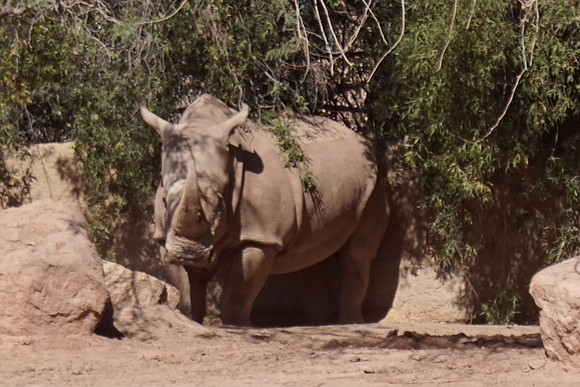
Southern white rhinos are often the color of the mud they wallowed in that day. When it’s hot, rolling around in mud puddles cools and protects their skin from sun and insects. Underneath all that mud, these rhinos are grey. The common explanation is that the word white in their name is a corruption of an Afrikaans word derived from the Dutch word for wide, spelled alternately wijd, wijde, weit, weid, widt, wyd or wyt. Wide is in reference to the shape of their mouth, which enables the rhino to get low to the ground and easily eat the short grasses prevalent in grassy savannas where they live.
However, there is no record of any variations of such a word being used to describe or identify a rhinoceros, and the Afrikaans word typically used in such instances is “breed.” There are several other theories on the origin of the moniker. One suggests that those who first named them encountered rhinos who’d been wallowing in white, calcium-rich mud, or that they were named in contrast to black rhinos, whose name origin is just as puzzling, as they are also grey in color.
Southern white rhinos are huge. On land, only elephants are larger. They are virtual eating machines that spend about half their waking hours consuming plants and will eat roughly 120 pounds of grass per day. Considered the most sociable of rhinos, groups of up to 14, primarily females and their offspring, will stay together. Male rhinos are generally solitary. They defend their roughly one-square-mile territories from other males, but more easily tolerate females and their young, who roam among different male territories.
This species was thought to be extinct until 1895, when a small population of less than 100 rhinos was found in South Africa. After a century of conservation efforts, the population increased to over 12,000. As of 2022, there is an estimated 16,000 rhinos living primarily in protected areas and reserves in South Africa, Namib