2025 0322 029
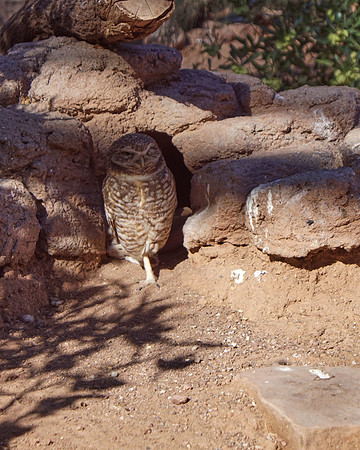
Burrowing Owl
Athene cunicularia
Most birds create a “whoosh” sound as air rushes over their wings when flying. But burrowing owls (like all owls) have specialized feathers in various parts of their bodies that allow them to fly silently. On the leading edge of a burrowing owl’s wing, the feathers have a serrated edge that breaks up the air, eliminating the “whoosh” sound. The feathers on the trailing edge of the wing have a fringe structure that serves a similar purpose. Also, the rest of the feathers on their wings and legs are softer and downier than many other species, helping to absorb high frequency sounds that most prey would be sensitive to. These features make them quiet and efficient hunters.
Burrowing owls typically live in grasslands, prairies, or deserts with open areas and sparse vegetation. They spend most of their time on low perches or on the ground, and nest and brood in burrows underground. Depending on the area, they may construct their own burrows or use burrows created by other species, like prairie-dogs, ground squirrels, kangaroo rats or other animals.
Burrowing owls can be greatly impacted by habitat loss and urbanization. Here in Phoenix, Arizona there have been efforts to protect threatened local populations by the Nina Mason Pulliam Rio Salado Audubon Center and Wild at Heart Raptor Rescue. Actions include building artificial burrows and releasing rehabilitated owls in the area to live and nest in them. Children and adults all over Arizona helped build these artificial habitats, providing homes for thousands of burrowing owls.
World
Diet: rodents, invertebrates, bats, birds, reptiles, amphibians
Zoo Diet: specialized carnivore diet, whole prey/mice
Habitat: grasslands, deserts
Wingspan: 20 – 24 in