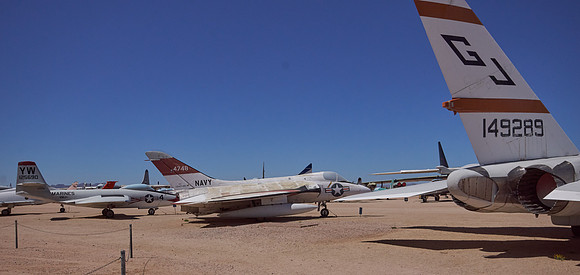
2025 0324 231
McDonnell F2H-2P Banshee
The Banshee was developed as an enlarged version of the McDonnell FH-1 Phantom. The aircraft featured more powerful engines and greater armament than the earlier aircraft. The F2H-1 prototype first flew on January 11, 1947 and operational aircraft reached service in March 1949. By the end of 1949 the F2H-2 version of the aircraft was in service. It featured a longer fuselage and wings which allowed more fuel to be carried, increasing the plane’s range. The F2H-3 and F2H-4 featured an even longer fuselage and more fuel as well as a search radar making them all-weather and night capable. The F2H-2 was also modified into a photo reconnaissance version with a lengthened nose housing several cameras. The Banshee was used extensively during the Korean War as both a fighter and a reconnaissance plane. Banshees were also sold to Canada and served in the Canadian Navy from 1955 until 1962. The last Banshees left the U.S. Navy’s inventory in 1965.
Grumman F9F-8B (TAF-9J) Cougar
Even before the F9F Panther entered service the Navy and Grumman were examining the possibility of creating a swept-wing version of the aircraft. The appearance of the Soviet MiG-15 over Korea spurred on the process and the prototype made its first flight in September 1951. While the Cougar retained the F9F designation of the earlier Panther it was an almost entirely new design bearing only a superficial resemblance to the Panther. Initially seen as an interim design the Cougar turned out to be very adaptable and several versions and modifications were made over its lifetime. Eventually nearly 2,000 were built and they remained in service until 1974.
The F9F-8 version featured an enlarged wing and more fuel capacity resulting in longer range and better low-speed handling. When tactical nuclear weapons were introduced in the mid-1950s the Navy selected several F9F-8s for conversion to carry the new weapons. These aircraft were equipped with the Low Altitude B