2025 0324 232
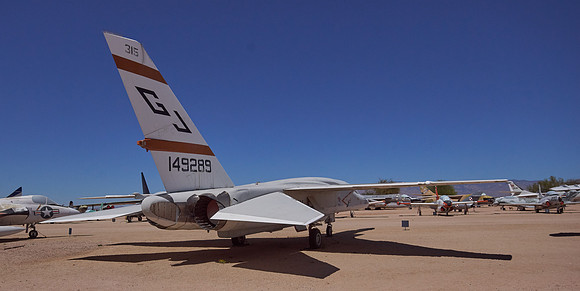
North American RA-5C Vigilante
The Vigilante is one of the largest aircraft to routinely fly from the U.S. Navy’s aircraft carriers. It was designed in the late 1950s as a supersonic nuclear capable attack bomber. The Vigilante first flew in August 1958 and deliveries of operational aircraft began in 1960. The A3J, as it was then designated, featured a unique bomb bay arrangement in which the bomb was ejected out a chute that exited between the aircraft’s engines. This system proved to be very troublesome and in fact many problems were never solved. A change in policy eliminated the Navy’s strategic nuclear bombing role and the Vigilante’s mission was changed to reconnaissance. At the same time the Navy’s aircraft designation system was changed and the A3J became the A-5A and the reconnaissance version became the RA-5C. Existing Vigilantes were upgraded and modified to serve as photo reconnaissance aircraft and further examples were built in the new configuration. The Vigilante served with the U.S. Navy until 1979.
Wingspan53 ft
Length76 ft 6 in.
Height19 ft 4 in.
Weight79,588 lbs (loaded)
Maximum Speed1,385 MPH
Service Ceiling48,400 ft
Range3,000 miles
EnginesTwo General Electric J79-GE-10 turbojets with 10,800 pounds of thrust each
Crew2
ManufacturerNorth American
MarkingsHeavy Reconnaissance Attack Squadron 3 (RVAH-3), Naval Air Station Albany, Georgia, 1970
DesignationRA-5C
Serial Number149289
Service History
Manufactured by North American Aviation, Columbus, Ohio and delivered to the U.S. Navy as an A-5A on December 17, 1962.
January 1963: To Heavy Attack Squadron 1 (VAH-1), Naval Air Station Sanford, Florida. Deployed on USS Independence.
August 1963: : To Heavy Attack Squadron 3 (VAH-3), Naval Air Station Sanford, Florida. Deployed on USS Independence.
August 1964: : To North American Aviation, Columbus, Ohio for conversion to RA-5C.
January 1966: To Heavy Reconnaissance Attack Squadron 6 (RVAH-6), Naval Air Station Mirama