2025 0324 163
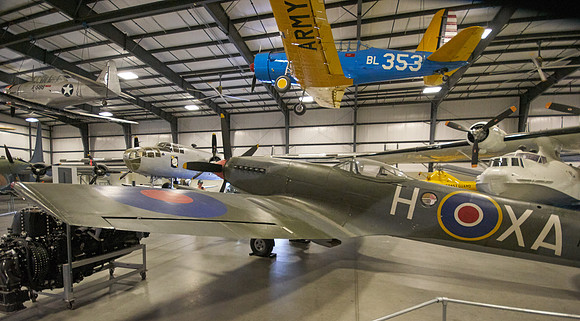
Supermarine Spitfire FR. XIVe
The Spitfire is widely regarded as the best British fighter of World War II, and was the only British designed fighter to remain in production for the entire length of the war. Design of the Spitfire began in 1934, with the first prototype flying the following year. The Spitfire entered service in 1938 just one year before World War II began. It was during the Battle of Britain in the Summer and Fall of 1940 that the Spitfire would become the symbol of British resistance to the German Luftwaffe’s attack, despite being outnumbered in Royal Air Force service by the Hawker Hurricane. The Spitfire proved to be a very adaptable design with versions dedicated to everything from short range interceptors to high speed photo reconnaissance.
The Mark XIV included many changes to the original Spitfire design. Most notable are the change from the Rolls Royce Merlin engine to the larger and more powerful Rolls Royce Griffon engine, which required a redesign of the aircraft’s nose, and the use of a five-bladed propeller. The fuselage was further redesigned to incorporate a bubble type canopy that gave much greater visibility for the pilot. The “FR” or fighter-reconnaissance version also added a fuselage mounted camera located behind the cockpit that could be pointed out a window on either side of the plane. Finally, the famous elliptical wing was redesigned with the wing tips shortened and squared off to improve the aircraft’s performance at lower altitudes.
Wingspan32 ft. 7 in.
Length32 ft. 8 in.
Height10 ft
Weight8,500 lbs (loaded)
Maximum Speed446 mph
Service Ceiling43,500 ft
Range850 miles
EngineOne Rolls-Royce Griffon 65 with 2,050 horsepower
Crew1
ManufacturerSupermarine
MarkingsRoyal Air Force 1945
DesignationSpitfire
Serial NumberMT847
Suspended Aircraft above:
AT-6 Texan, https://pimaair.org/museum-aircraft/north-american-t-6g/
BT-13 Valiant, https://pimaair.org/museum-aircraft/vultee-bt-13a-valiant/
North