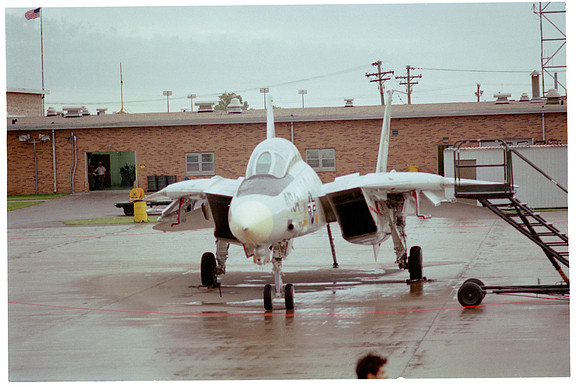
a07 F-14A Tomcat Nose
The F-14A 'Tomcat' was equipped with two Pratt & Whitney TF30 turbofan engines, providing a total thrust of 20,900 lbs and giving the aircraft an official maximum speed of Mach 2.34. Both of the engine's rectangular air intake ramps were equipped with movable ramps and bleed doors to meet the airflow requirements of the engine but prevent dangerous shockwaves from entering. de Laval nozzles were also fitted to the engine's exhaust.
The performance of the TF30 engine became an object of criticism. John Lehman, Secretary of the Navy in the 1980s, told the U.S. Congress that the TF30/F-14 combination was "probably the worst engine/airframe mismatch we have had in years" and that the TF30 was "a terrible engine"; 28% of all F-14 accidents were attributed to the engine. A high frequency of turbine blade failures led to the reinforcement of the entire engine bay to limit damage from such failures. The engines also had proved to be extremely prone to compressor stalls, which could easily result in loss of control, severe yaw oscillations, and could lead to an unrecoverable flat spin. At specific altitudes, exhaust produced by missile launches could cause an engine compressor stall; leading to the development of a bleed system[clarification needed] to temporarily reduce engine power and block the frontal intake ramp during missile launch. With the TF30, the F-14's overall thrust-to-weight ratio at maximum takeoff weight is around 0.56, considerably less than the F-15A's ratio of 0.85; when fitted with the General Electric F110 engine, an improved thrust-to-weight ratio of 0.73 at maximum weight and 0.88 at normal takeoff weight was achieved.