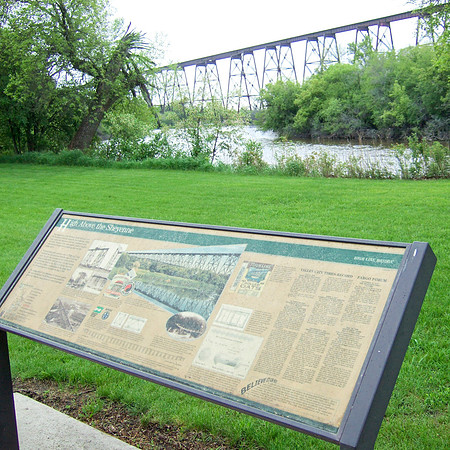
High Above the Sheyenne
The original line of the Northern Pacific Railroad, now the Burlington Northern Santa Fe, descended into Valley City, crossed the Sheyenne River and continued out of the valley. Because of the steep grades, "pusher" engines were required to push heavy trains up and onto the plains above.
To avoid these severe grades a new or "High Line" track was bullet one mile upstream from the old or "Low Line" track. The new line branches off the old line at Pead, skirts the hills which surround Valley City and crosses the Sheyenne River on the High Line Bridge, rejoining the old line at Berva. Construction on the bridge began in 1906 and was ready for trains on May 8, 1908.
The bridge was of vital importance in moving supplies and men during both World Wars and was guarded by State and National Guard troops to prevent sabotage.
The original line of the Northern Pacific Railroad descended from the east,crossed the Sheyenne River at Valley City over a low bridge, and climbed out of the valley to the west. Because of the depth of the valley, the grades on either side of the river were severe. To avoid these severe grades, the new or "High Line" was built one mile upstream.
At 3,860 feet long and 162 feet above the river bed, the Highline Bridge is one of the longest and highest single-track railroad bridges in the nation. Work began on June 30, 1906. The first official train crossed the trestle on May 12, 1908 and regular train service over the bridge began May 20th.
Because the bridge was of vital importance in moving supplies and men, it was closely guarded during both World Wars to prevent sabotage.
In World War I, the bridge was guarded by Company H North Dakota National Guard of Jamestown. Following the bombing of Pearl Harbor on Dec. 7, 1941, volunteers from the American Legion, VFW, city and railroad personnel took up the watch until Company F of the North Dakota State Guard was officially mustered in.
In 2004, the High Line Bridge was listed as a National Civil Engine