DSCF0143
'Cat'houses & Sporting Women
###Hello Dolly. viewing NE from Dolly's No. 24 Circa Late 1920s. Thelma Dolly Copeland whose 'stage name became Dolly Arthur was born in 1888 near McCall, Idaho but fled west at age 13 to escape a troubled family life. By age 18 she found selling her favors more lucrative than waiting tables.
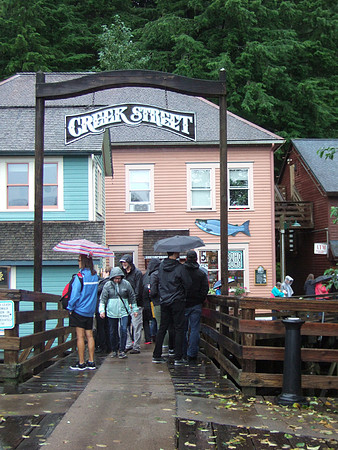
Ketchikan's notorious Creek Street
Alaska's First City northbound was transportation and supply hub first for mining, then fishing and later to timber industries. Ketchikan's male-worker populations sometimes seemed to math its local census count and prostitution flourished for more than 50 years. And then in 1954, it was banished.
No. 5 "The Star" Dance Hall. More than two "Female boarders" constituted a house of prostitution under Territorial Alaska law, so most Creek Street ladies lived in pairs or alone.
City Council planted the Creek's red-light roots
with an 1903 formal edict ordering all bawdy houses moved to a single
location in the Creek Street area. Ramshackle sporting houses built
upon piling sprang up on both sides of the creek. Fourteen operated
in 1914: in 1920, 31 "female boarders" occupied 21 houses, and
after World War II some 33 houses were listed. Starting upstream,
numbers ran No. 1 to No. 24 with exceptions like unlucky No. 13.
dubbed simply- "The End." Houses burned or collapse over the
years and some were replaced. Several abatement efforts closed the
Creek for brief periods in the 'teens and `20s. With great irony, final
closure came in 1954 after a lengthy federal grand jury investigation
exposed police graft and city tolerance. There are people still angry
to this day over the closure that put 22 girls in 18 houses out of
business.
It was a bazaar of red-light vice for half a century, but Creek Street also served as a clearinghouse, news and job center for the fishing fleet. After weeks on the fishing grounds, fishermen
appreciated Creek Street parlors as places for socializing and after hours drinks as much as for the