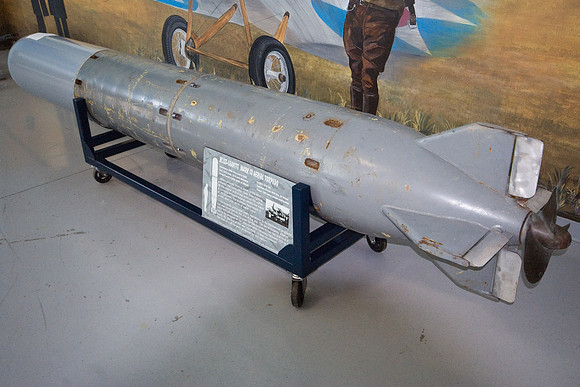
Bliss-Leavitt Mark 13 Aerial Torpedo
When dropped from a plane, a trip delay prevents the combustion flask from lighting off the engine until it has entered the water. A correctly dropped torpedo enters the water at 30-degrees. The exploder mechanism is armed after 200 yards of water travel.
The torpedo underwent many operations to fix mechanical problems. but was corrected by the end of the war. The aerial torpedo attacks were difficult because in order for the torpedo to run hot and true it had to be dropped at low altitudes while traveling between 150 to 200 knots. By the end of the war, the Mark 13 was considered the best aircraft torpedo produced by any nation.
The restoration of the Bliss-Leavitt is being done by WWII veteran Stew Bass, Vietnam veteran Robert Miller, and youth volunteers Damien Gehler..
Specifications:
Invented in 1930, first used in 1935.
Size 13 ft. long - 22.4 diameter
Range/Speed: 6,300 yards at 39 mph
Weight: 2216 lbs.
Explosive charge: 600 lbs. of Torpex
Power: 100 horse power wet-heater.