S14 0050-1036
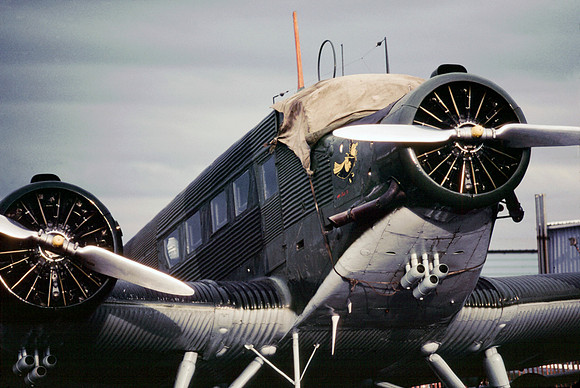
Junkers Ju-52 'Tante Ju' (Aunt Ju) and 'Iron Annie'. Photo by Bob Nelson
The Ju 52 had a low cantilever wing, the midsection of which was built into the fuselage, forming its underside. It was formed around four pairs of circular cross-section duralumin spars with a corrugated surface that provided torsional stiffening. A narrow control surface, with its outer section functioning as the aileron, and the inner section functioning as a flap, ran along the whole trailing edge of each wing panel, well separated from it. The inner flap section lowered the stalling speed and the arrangement became known as the DoppelflŸgel, or "double wing". The outer sections of this operated differentially as ailerons, projecting slightly beyond the wingtips with control horns. The strutted horizontal stabilizer carried horn-balanced elevators which again projected and showed a significant gap between them and the stabilizer, which was adjustable in-flight. All stabilizer surfaces were corrugated. The aircraft's unusual corrugated duralumin metal skin, pioneered by Junkers during World War I, strengthened the whole structure. -wiki