1995 0813y17
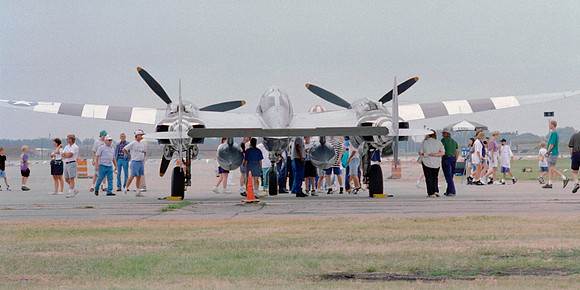
P-38J-20-LO 'Lightning' "Joltin' Josie"; Josie Pond, owner of 44-23314, NX38BP.
The Lockheed team chose twin booms to accommodate the tail assembly, engines, and turbo-superchargers, with a central nacelle for the pilot and armament. Test flights revealed problems initially believed to be tail flutter. During high-speed flight approaching Mach 0.68, especially during dives, the aircraft's tail would begin to shake violently and the nose would tuck under, steepening the dive. Once caught in this dive, the fighter would enter a high-speed compressibility stall and the controls would lock up, leaving the pilot no option but to bail out (if possible) or remain with the aircraft until it got down to denser air, where he might have a chance to pull out.
The P-38's dive problem was revealed to be the center of pressure moving back toward the tail when in high-speed airflow. The solution was to change the geometry of the wing's lower surface when diving in order to keep lift within bounds of the top of the wing. In February 1943, quick-acting dive flaps were tried and proven by Lockheed test pilots. The dive flaps were installed outboard of the engine nacelles, and in action they extended downward 35¡ in 1.5 seconds. The flaps did not act as a speed brake; they affected the pressure distribution in a way that retained the wing's lift. -[wiki]
Photo by Craig on Sunday, August 13, 1995 at the Fargo Airsho.