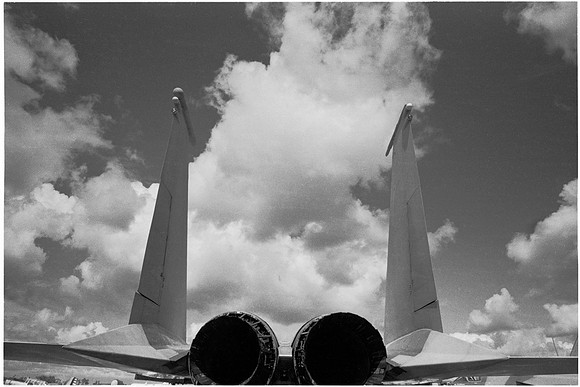
1092.31 F-15 tails engines
The F-15 'Eagle' has an all-metal semi-monocoque fuselage with a large cantilever shoulder-mounted wing. The empennage is metal and composite construction, with twin aluminum/composite material honeycomb structure fins with boron-composite skin, resulting in an exceptionally thin tailplane and rudders with all-moving composite horizontal tail surfaces outboard of the fins. The F-15 has a spine-mounted air brake and retractable tricycle landing gear. It is powered by two Pratt & Whitney F100 Axial compressor turbofan engines with afterburners mounted side-by-side in the fuselage, fed by intake ramps. The cockpit is mounted high in the forward fuselage with a one-piece windscreen and large canopy to increase visibility. The airframe began to incorporate advanced superplastically formed titanium components in the 1980s.
The F-15's maneuverability is derived from low wing loading (weight to wing area ratio) with a high thrust-to-weight ratio enabling the aircraft to turn tightly without losing airspeed. The F-15 can climb to 30,000 feet in around 60 seconds. The thrust output of the dual engines is greater than the aircraft's weight, thus giving it the ability to accelerate in a vertical climb. The weapons and flight control systems are designed so that one person can safely and effectively perform air-to-air combat.