2025 0322 102
Komodo Dragon
Varanus komodoensis
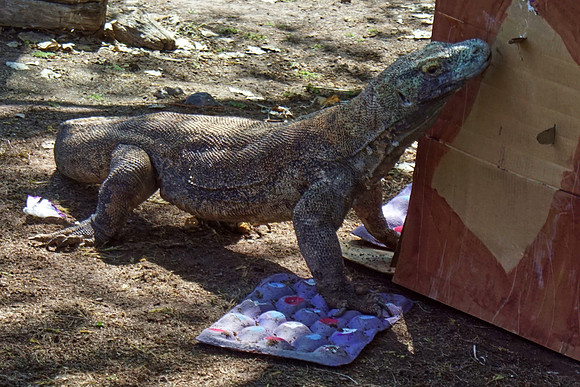
Komodo dragons are considered the largest living lizard species on the planet. Large adult males can weigh more than 200lbs and reach 10 feet in length. These lizards use this size to their advantage when attacking and subduing large prey, as well as when males fight for territory and breeding rights to females. While it may be the largest lizard, the Komodo dragon is not the longest lizard. This honor belongs to the crocodile monitor (Varanus salvadorii), a relative to the Komodo dragon native to Papua New Guinea.
When young, Komodo dragons are mostly arboreal, living in trees and large shrubs. This lifestyle allows youngsters to avoid adults, who see them as possible prey. Once they are large enough to fend for themselves, Komodo dragons live a primarily terrestrial lifestyle, hunting and resting mainly on the ground.
Previous thinking on Komodo dragons was that the lizards used “weaponized bacteria” in their saliva to help subdue prey. While there is, indeed, a lot of bacteria present in a Komodo dragon’s mouth, it is no longer considered to be important to hunting. Current research suggests that they produce a cocktail of proteins that are similar to those found in rattlesnake venom. These proteins are not considered deadly or overly potent, but they may increase bleeding and decrease clotting at wound sites to allow prey to bleed out quicker.
Diet: mammals, reptiles, birds, eggs, invertebrates, carrion
Zoo Diet: Whole prey
Habitat: grasslands, savannas, monsoon forests
Length: 7 – 10 ft