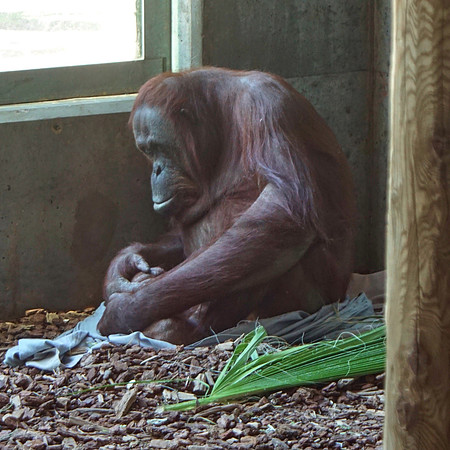
2025 0322 095
Bornean Orangutan
Pongo pygmaeus
Orangutans are built for life in the trees. Their arms are long and muscular – males can reach over seven feet from fingertip to fingertip – and their hands and feet are well adapted for grasping. Capable of weighing over 200 lbs, they are too heavy to jump between branches, as monkeys do. But their strong and supple joints allow them to easily move from branch to branch and tree to tree using all four limbs via a method known as quadrumanous clambering. Orangutans, especially adult males, will occasionally leave the trees and walk on the ground to find food or a new territory. On the ground, they typically walk on all four legs, but are capable of walking on two legs (bipedally) if need be.
Orangutans are among the most intelligent primates and one of our closest relatives, sharing an estimated 97 percent of our genes. Like humans, orangutans have four fingers and a thumb with fingernails, rather than claws. This combination of big brains and dexterous hands enables them to use tools, and manipulate their environment as needed. They use sticks to test water depth or to poke around in termite holes looking for a treat. They use leaves and engineering skills to construct new nests in the trees each night. They make leaf umbrellas for rain or sun protection, sponges from chewed leaves to soak up drinking water from tree cavities, and chewed leaf napkins to wipe their hair and faces. Like many of us, they learn all these skills from their mothers.
Bornean orangutans live a semi-solitary life. Unlike most primates, they do not form large social groups, however they will be familiar with other orangutans in their area. Subadults and adolescents will occasionally associate with each other, and it’s not unusual for several orangutans to feed near each other when food is abundant. Dominant males are the most solitary, except during courtship or when fighting other males for access to receptive females. The relationship between a mot