2025 0322 041
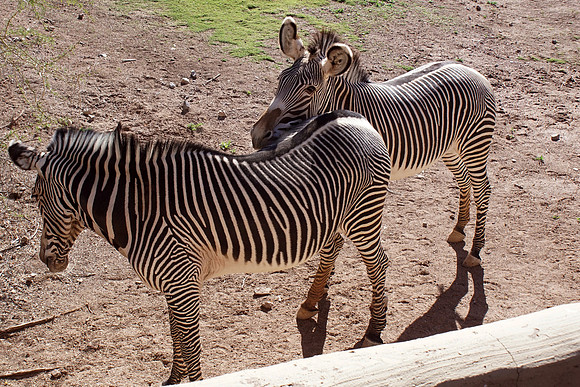
Grevy's Zebra
Equus grevyi
The Grevy’s zebra, which lives in semi-arid grasslands with few trees in Kenya and Ethiopia, is sometimes referred to as the Regal Zebra. It got this name because the Abyssinian Emperor Menelik II thought this zebra was so majestic that he gave one to French President Jules Grevy in 1882. It was thereafter called the Grevy’s zebra. It is also regal because it is the largest of the three zebra species, weighing up to 1,000 pounds. The only larger member of the equine family is the domesticated horse.
A member of the horse family (Equidae), the Grevy’s zebra is most closely related to the African wild ass. Its head is long, narrow and mule-like; its ears are big, round and fuzzy, and its mane is erect, rather than flowing like a horse’s. Like a horse, the Grevy’s zebra is an herbivore, eating mostly grass and sometimes tree bark and leaves, but unlike most mammals, it can go up to five days without drinking water. This zebra communicates with other zebras with a donkey-like bray, rather than the “neigh” associated with horses. The Grevy’s zebra can run up to 40 mph and has good stamina, enabling it to escape predators like lions which tire quickly, but horses are still faster. Also, this zebra is far more temperamental, aggressive and stubborn than a horse, which makes it almost impossible to tame.
Unlike other equines, the Grevy’s zebra does not form permanent herds or social bonds among adults. It lives in a herd, but the herd’s composition can vary daily as members enter and leave; and associations among members rarely last more than a few months. The most stable relationships for this zebra are a mare’s attachment to her young, from one to three years; and a stallion’s attachment to its territory. It’s territory, at up to seven square miles, is largest of any herbivore.
Within the herd, there is little dominance or hierarchy. If there are no females to compete for, males will associate with other stallions i