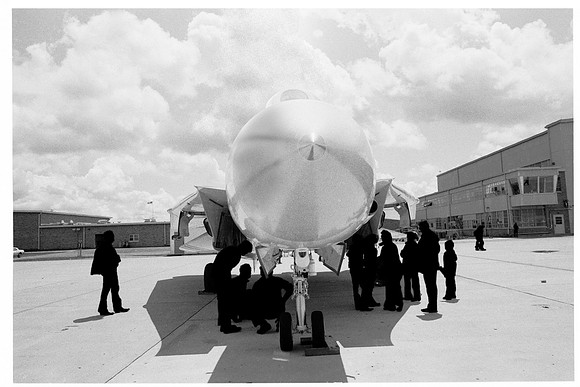
e00a1 F-14 Tomcat wide nose
The F-14 was initially equipped with two Pratt & Whitney TF30 (or JT10A) turbofan engines, providing a total thrust of 5.670/9.480 kg/t and giving the aircraft an official maximum speed of Mach 2.34. Both of the engine's rectangular air intakes were equipped with movable ramps and bleed doors to meet the airflow requirements of the engine but prevent dangerous shockwaves from entering. Variable nozzles were also fitted to the engine's exhaust.
The cockpit has two seats, arranged in tandem, outfitted with Martin-Baker GRU-7A rocket-propelled ejection seats, rated from zero altitude and zero airspeed up to 450 knots.[37] The canopy is spacious, and fitted with four mirrors to provide effectively all-round visibility. Only the pilot has flight controls; the flight instruments themselves are of a hybrid analog-digital nature. The cockpit also features a head-up display (HUD) to show primarily navigational information; several other avionics systems such as communications and direction-finders are integrated into the AWG-9 radar's display. A significant feature of the F-14 was its Central Air Data Computer (CADC), designed by Garrett AiResearch, that formed the onboard integrated flight control system. It used a MOS-based LSI chipset, the MP944, making it possibly the first microprocessor in history.
(Wikipedia)
Crowd silhouetted out in Adobe Photoshop. The nose and some of the clouds had to be recreated due to lens flare.