2025 0324 237
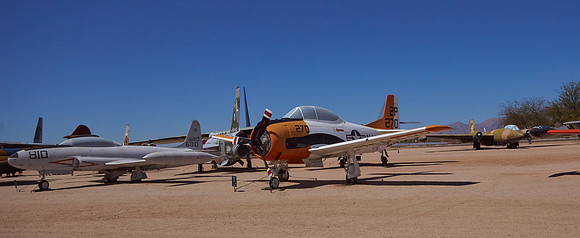
Lockheed TV-2 (T-33B) Shooting Star
In 1947, the P-80s high accident rate caused Lockheed to design a two-seat trainer version of the P-80C to combat the problem. The T-33 is significantly longer than the P-80 and adds wingtip fuel tanks to make up for fuel storage in the fuselage lost to the second seat. The Shooting Star was adopted by the U.S. Navy as well as the Air Force. In Navy service they were initially designated as the TV-2, later they were redesignated as the T-33B. They are in all ways identical to the Air Force version of the aircraft.
Wingspan38 ft 10 in.
Length37 ft 9 in.
Height11 ft 4 in.
Weight11,965 lbs (loaded)
Maximum Speed543 MPH
Service Ceiling47,500 ft
Range1,275 miles
EngineOne Allison J33-A-35 turbojet with 4,600 pounds of thrust
Crew2
ManufacturerLockheed
MarkingsMarine Corps Headquarters, Flight Section, Andrews AFB, Maryland, 1975
Serial Number136810
DesignationTV-2
North American T-28C Trojan
The North American T-28 Trojan was developed as a primary training for the U.S. Air Force in 1948 and entered service in 1950. The U.S. Navy introduced the T-28 in 1953, more than three years after it entered service with the U.S. Air Force. The Navy’s version of the aircraft, the T-28B, differed from the Air Force version primarily in having a larger engine and a three-blade propeller instead of a two-blade prop. The T-28C was basically identical to the B-model except that it added a tail hook usable for carrier landings. The Trojan served with the U.S. Navy until 1984.
Service History
Manufactured by North American Aviation, Columbus, Ohio and delivered to the U.S. Navy on May 8, 1956.
July 1965 To Fleet Reserve, Naval Air Station Pensacola, Florida.
September 1965 To Training Squadron 3 (VT-3), Naval Air Station Whiting Field, Florida.
May 1968 To Naval Reserve Fleet, Pensacola Naval Air Station, Florida.
September 1968 To Training Squadron 3 (VT-3), Naval Air Stat