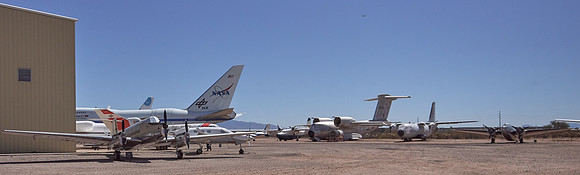
2025 0324 042
De Havilland Australia DHA-3 Drover MK. 2, https://pimaair.org/museum-aircraft/de-havilland-australia-dha-3-drover-mk-2/
Adam A500 CarbonAero, https://pimaair.org/museum-aircraft/adam-a500/
Dassalt HU-25A Guardian, https://pimaair.org/museum-aircraft/dassault-hu-25a/
Grumman HU-16B Albatross, https://pimaair.org/museum-aircraft/grumman-hu-16b-albatross/
Boeing YC-14, https://pimaair.org/museum-aircraft/boeing-yc-14/
Aeritalia C-27A Spartan, https://pimaair.org/museum-aircraft/aeritalia-c-27a-spartan/
Boeing YC-14
The YC-14 was designed in the early 1970s as a possible replacement for the C-130. It and the McDonnell-Douglas YC-15 competed in U.S. Air Force tests during 1976 and 1977. While both aircraft performed well, neither one was selected for production. Instead, the Air Force settled on an improved version of the C-130. The YC-14 introduced several new technologies and techniques in aircraft design, the most obvious of them is the positioning of the jet engines to exhaust over the top of the wing. This, along with specially designed flaps, allows the jet thrust to provide additional lift, giving the plane a very impressive short-field performance and allowing it to land at as little as 99 miles per hour.
Wingspan129 ft
Length131 ft 8 in.
Height48 ft 2 in.
Weight249,000 lbs (loaded)
Cruising Speed472 MPH
Maximum Altitude30,000 ft
Range3,000 miles
EnginesTwo General Electric CF6-50D turbofans with 51,000 pounds of thrust each
Crew3 flight crew, 150 troops
ManufacturerBoeing
MarkingsBoeing/Air Force Flight Test Center, Edwards AFB, California, 1977
Serial Number72-1873
DesignationYC-14