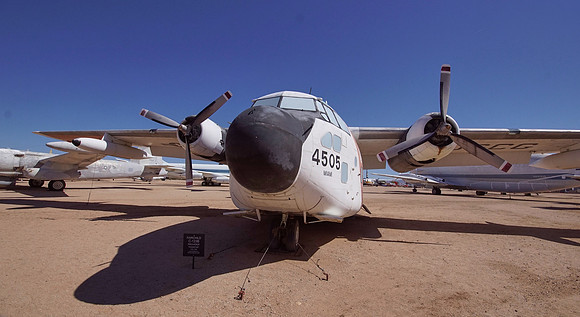
2025 0324 021
Grumman E-1B (WF-2) Tracer
Grumman began work on modifying the S2F Tracker into an airborne radar platform in 1955 as a company funded project. At the same time the Navy was working on a request for proposals for just such an aircraft and Grumman offered their new design as a temporary solution while the Navy finalized their requirements. After the Navy agreed work on the design continued into 1956 with several changes being made to the design. Most importantly the TF-1 Trader was adopted as the basic fuselage from which the Tracer would be modified because the Trader which was itself derived from the S2F had a wider fuselage giving more room for electronic equipment. The first WF-2 flew on March 1, 1958 and operational aircraft began arriving at active squadrons in early 1960. Initially planned as an interim design the Tracer was the Navy’s primary carrier based airborne radar aircraft until the mid-1970s. The last of the 88 Tracers built left Navy service in November 1977.
Wingspan: 72 ft 7 in.
Length: 45 ft 4 in.
Height: 16 ft 10 in.
Weight: 26,600 lbs (loaded)
Maximum Speed: 227 MPH
Service Ceiling: 15,800 ft
Range: 1,010 miles
Engines: Two Wright 1820-82A radial engines with 1,525 horsepower each
Crew: 4
Manufacturer: Grumman
Markings: Airborne Early Warning Squadron 307 (VAW-307), Naval Air Station North Island, California, 1974Serial Number: 147227
Designation: E-1B
https://pimaair.org/museum-aircraft/grumman-e-1b/
Lockheed AP-2H Neptune
Designed as a long-range anti-submarine patrol plane the Neptune first flew on May 17, 1945 and P2V-1s and -2s entered service with the U. S. Navy in March 1947. Steady technological upgrades and new orders kept the Neptune in production until April 1962. The final production version, the P2V-7 (later P-2H), began coming off the assembly line in 1954 and was the first version built with underwing jet engines.
The AP-2H designation was applied to four heavily modified SP-2H aircraft for a special program during the Viet