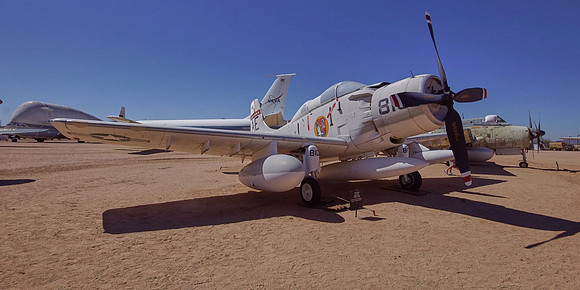
2025 0324 017
Douglas EA-1F (AD-5Q) Skyraider
The design of the Douglas Skyraider dates to 1943 when the U.S. Navy requested a single seat aircraft capable of acting as both a dive bomber and a torpedo bomber. The prototype first flew in March 1945. The design was very well received during testing and the first aircraft entered service in 1946 as the AD-1. The Skyraider proved to be a very adaptable design and production of eight major models and thirty-seven variants continued until 1957 with 3,180 built. The basic AD-5 model appeared in 1950 as a two seat anti-submarine aircraft with a wider and slightly longer fuselage. The larger fuselage allowed more extensive modification into a four seat electronic countermeasures aircraft designated AD-5Q. In 1962, these aircraft were redesignated as EA-1F. A small number of them remained in service as late as 1979.
Wingspan 50 ft 9 in.
Length 40 ft 1 in.
Height 15 ft 10 in.
Weight 18,799 lbs (loaded)
Maximum Speed 200 MPH
Service Ceiling 26,000 ft
Range 1,202 miles
Engine One Wright R-3350-26WA radial engine with 2,700 horsepower
Crew 4
Manufacturer Douglas
Markings VAW-33, USS America, 1967
Serial Number 135018
Designation EA-1F
Fairey AEW.3 Gannet
Designed in response to a 1945 Royal Navy request for a dedicated anti-submarine aircraft the first Gannet flew in 1949, but did not enter service until 1955. The Gannet is widely regarded as one of the least attractive aircraft ever built, however its large fuselage made it ideal for adaptation to other uses. Introduced in 1959, the AEW.3 variant was designed as an airborne early warning aircraft for fleet defense. The addition of the large bulged radar dome under the fuselage did little for the Gannet’s looks, but it did give the Royal Navy radar coverage of their fleet out to 200 miles from the aircraft. The other main versions of the Gannet were a trainer and a transport for moving people and cargo to a carrier at sea. The Gannet served with the Royal Navy until 1