2025 0324 241
Ship: USS Enterprise, NCC-1701
Introduction: Star Trek (1966–1969)
The USS Enterprise, led by Captain James T. Kirk, is the main setting of the original Star Trek series and Star Trek: The Animated Series (1973–74).
Matt Jefferies designed the ship, and its core components – a saucer-shaped primary hull, and cylindrical secondary hull, and a pair of outriding engine nacelles – established the core ship design for the franchise. Enterprise footage was rotoscoped for its depiction in the animated spinoff.
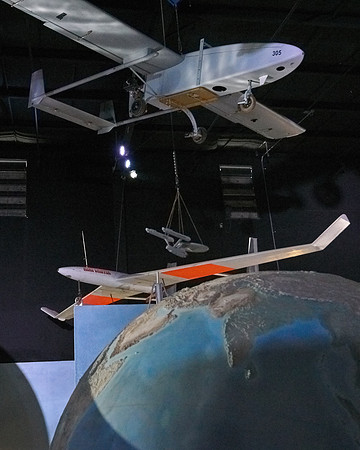
Other early UAV suspended over a large relief globe.
NASA Mini-Sniffer II
The Mini-Sniffer program began in 1975 as an unmanned aerial vehicle designed to conduct air sampling at high altitudes. Developed by the NASA Dryden Flight Research Center, the Mini-Sniffer was designed as a cheaper alternative to manned high altitude aircraft. The Mini-Sniffer I was built with canards, swept wings and was powered by a small two stroke gas powered go-kart engine. After a hard landing, it was decided to modify the aircraft into a new design. The modifications included removing the canards and adding wing tips and tail booms. The redesign also added a gyroscope allowing the aircraft to remain level by rudder inputs alone. The modified Mini-Sniffer II on display here flew twenty flights up to altitudes of 20,000 feet.
The follow up design was the larger but lighter Mini-Sniffer III. The Mini-Sniffer III was powered by a non-air-breathing hydrazine engine that could take the aircraft and its payload up to 90,000 feet. There were also proposals to explore the atmosphere of Mars with Mini-Sniffer III drones. Unfortunately, the Mini-Sniffer III only flew one flight to 20,000 feet before hydrazine started leaking. The aircraft never flew again and the program was canceled.
Wingspan21 ft 3 in.
Length12 ft 4 in.
Service Ceiling20,000 ft
EngineOne McCulloch MC91B/1 two stroke single cylinder engine
https://pimaair.org/museum-aircraft/mini-sniffer/
L-3 Unmanned Systems/B