2025 0324 173
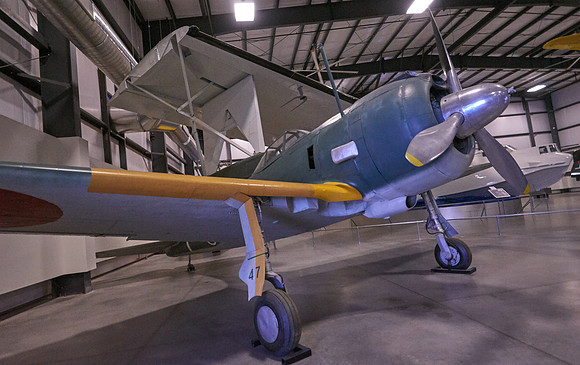
Nakajima Ki-43 Hayabusa (Oscar)
The Nakajima Ki-43 Hayabusa (Peregrine falcon), formal Japanese designation Army Type 1 Fighter is a single-engine land-based tactical fighter that was used by the Imperial Japanese Army Air Service in World War II.
The Allied reporting name was "Oscar", but it was often called the "Army Zero" by American pilots because it bore a certain resemblance to the Mitsubishi A6M Zero, the Imperial Japanese Navy's counterpart to the Ki-43. Both aircraft had generally similar layout and lines, and also used essentially the same Nakajima Sakae radial engine, with similar round cowlings and Bubble canopy (the Oscar's being distinctly smaller and having much less framing than the A6M). While relatively easy for a trained eye to tell apart with the "finer" lines of the Ki-43's fuselage – especially towards the tail – and more tapered wing planform, in the heat of battle, given the brief glimpses and distraction of combat, Allied aviators frequently made mistakes in enemy aircraft identification, reportedly having fought "Zeros" in areas where there were no Navy fighters.
Like the Zero, the radial-engined Ki-43 was light and easy to fly and became legendary for its combat performance in East Asia in the early years of the war. It could outmaneuver any opponent, but did not initially have armor or self-sealing fuel tanks, and its armament was poor until its final version, which was produced as late as 1945. Allied pilots often reported that the nimble Ki-43s were difficult targets but burned easily or broke apart with a few hits.
Total production amounted to 5,919 aircraft, making it the second-most produced Japanese fighter aircraft during the war after the Mitsubishi A6M Zero. Many of these were used during the last months of the war for kamikaze missions against the American fleet. -Wikipedia
Wingspan35 ft 6 in.
Length29 ft 3 in.
Height10 ft 6 in.
Weight5,710 lbs (loaded)
Maximum Speed329 MPH
Service Ceiling36,750 ft
Range1095 miles