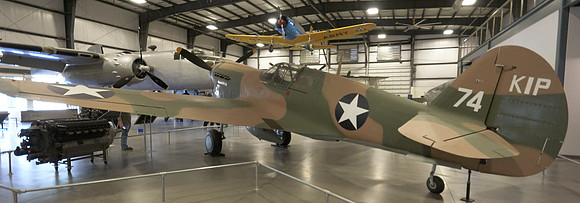
2025 0324 154
The P-40 is probably the most recognizable of the Curtiss Aircraft Company’s designs. Developed from the P-36A in 1938 the P-40 was technologically inferior to the fighters then in production and development elsewhere in the world. However, it was ordered in large numbers by the U.S. Army and in smaller numbers by the British and French primarily because it could be built quickly and in large numbers using existing production lines. The P-40E model was upgraded with six wing mounted .50 caliber machine guns in place of the original four wing guns. The P-40 remained in production until 1944 and served throughout the war, despite being superseded by newer designs. Curtiss built a total of 13,738 aircraft, by far the largest production run of any Curtiss design. This aircraft has been reconstructed from the parts of several P-40s.
Wingspan37 ft 4 in.
Length31 ft 9 in.
Height12 ft 4 in.
Weight8,840 lbs (loaded)
Maximum Speed354 MPH
Service Ceiling32,400 ft
Range716 miles
EngineOne Allison V-1710-33 with 1,040 horsepower
Crew1
ManufacturerCurtiss Aircraft Company
Markings49th Fighter Group, 9th Fighter Squadron, Papua New Guinea, 1942
Serial Number41-25163
Suspended Aircraft above:
AT-6 Texan, https://pimaair.org/museum-aircraft/north-american-t-6g/
BT-13 Valiant, https://pimaair.org/museum-aircraft/vultee-bt-13a-valiant/
Vultee BT-13A Valiant
Virtually every potential pilot trained by the Army Air Force in World War II did their Basic Flight course in a BT-13. The Valiant was an excellent trainer for new pilots since it had very docile handling characteristics. One feature of the aircraft that was not appreciated led to its unflattering nickname “Vibrator.” In high speed flight the canopy rattled in a disconcerting manner that tended to distract new pilots. The first BT-13s entered Army service in 1939 and eventually more than 11,000 were built.
Wingspan42 ft
Length28 ft 10 in.
Height11 ft 6 in.
Weight4,496 lbs (loaded)
Maximum Speed