2025 0324 151
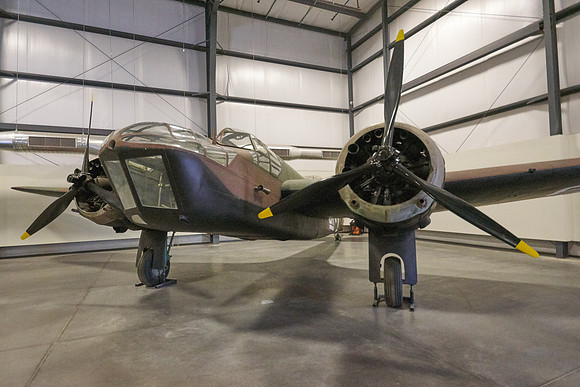
Bristol Bolingbroke Mk. IV
Development of the Blenheim began in 1935 as a development of a civil transport. When it first appeared, the Blenheim was faster than most of the fighters then in use by the Royal Air Force, but by the outbreak of war in 1939 it was slow and nearly obsolete. Nevertheless, it served extensively in the first three years of the war as a bomber, night-fighter, and reconnaissance aircraft. A version of the Blenheim Mk. IV was built in Canada by Fairchild called the Bolingbroke. These aircraft served primarily as coastal patrol planes and as trainers.
This Bolingbroke has been restored from the parts of several planes and has been painted to recreate the markings of serial number 9118 assigned to Royal Canadian Air Force No. 115 Squadron at Annette Island, Alaska. Bolingbroke 9118 was credited with assisting in the destruction of the Japanese submarine RO-32 in early July 1942 along with two US Coast Guard cutters. The aircraft dropped two depth bombs on the target. The next day the cutters reported sighting large air bubbles and oil in the water and a heavy smell of diesel fuel. Officially the RCAF crew and the USCG cutters shared credit for killing RO-32. In 1945, the very much intact RO-32 was captured in Japan and the credit for the sinking was rescinded. However, in the early 2000s a photo reportedly taken by the crew of 9118 was discovered which seems to prove that they had indeed attacked a submarine that day. It has been suggested that it was in fact a Soviet submarine. Both the Japanese and Soviet navies purchased submarines from the British-Vickers Engineering Co. between World War I and the 1930s. The subs were built to the same plans and were virtually identical. The Soviet submarine Shch-138 was reported missing two days after the attack off Annette Island. Soviet records say it was destroyed by a torpedo malfunction. However, Soviet submarines are known to have conducted espionage missions along the US and Canadian