2025 0324 120
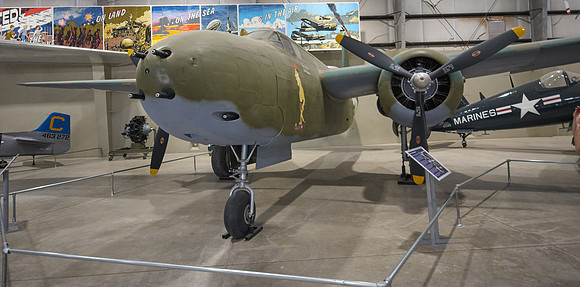
Douglas A-20G Havoc
Initial design work for the A-20 began in 1936 as a private venture of the Douglas Company to design a light attack and reconnaissance aircraft. Work was delayed by a series of major design changes that increased the size of the aircraft, gave it larger engines and focused the design as a bomber. First flown in October 1938 the aircraft attracted the interest of the French Air Force and the first orders actually came from France rather then the U.S. Army. France and Belgium briefly used the aircraft before those countries fell to the Germans. Many of the aircraft were diverted to Britain where they were operated under the names Boston and Havoc. The U.S. Army adopted the British name Havoc when they began receiving their A-20s after 1939. The A-20G was the most produced version of the Havoc and was optimized for low altitude attacks using a battery of six nose mounted machine guns and parachute equipped bombs called “parafrags.”
Wingspan61 ft 4 in.
Length48 ft
Height17 ft 7 in.
Weight24,127 lbs (loaded)
Maximum Speed317 MPH
Service Ceiling23,700 ft
Range2,100 miles
EnginesTwo Wright R-2600-23 radials with 1,620 horsepower each
Crew2
ManufacturerDouglas
Markings89th Bombardment Squadron, 3rd Bombardment Group, Fifth Air Force, Nadzab, New Guinea, 1944
DesignationA-20G
Serial Number43-9436