2025 0324 115
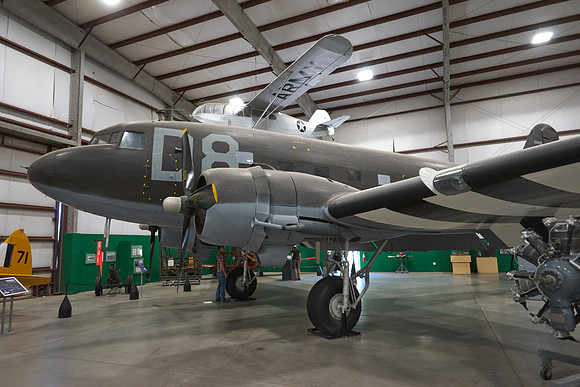
Douglas C-47 Skytrain
The Douglas C-47 is arguably the most successful aircraft to come out of World War II. It was designed in 1935 as the DC-3 commercial airliner. The aircraft was so far ahead of its competitors that over 400 had been built by 1940 when the U.S. Army Air Forces expressed an interest in a militarized cargo and troop transport version. The main modifications from the DC-3 version are a large cargo door on the left side of the aircraft and a strengthened floor. More than 9,500 Skytrains were built for all branches of the American military and for export. Large numbers of C-47s entered civil service after the war and as many as 400 of them were still flying around the world in 2017.
Wingspan95 ft 6 in.
Length63 ft 9 in.
Height17 ft
Weight26,000 lbs (loaded)
Maximum Speed230 MPH
Service Ceiling24,000 ft
Range1,600 miles
EnginesTwo Pratt & Whitney R-1830-92 with 1,200 horsepower each
Crew4 with 27 passengers
ManufacturerDouglas
MarkingsU.S. Army Air Forces, England, June 6, 1944
Serial Number41-7723
DesignationC-47
Taylorcraft TG-6
Early in World War II, the Army Air Forces recognized a requirement for a simplified training glider for beginning instruction of pilots who would go on to fly troop gliders in combat. The quickest solution was to modify existing civilian light aircraft designs to serve as gliders. The Piper, Aeronca, and Taylorcraft companies each modified one of their designs for Army use. The Taylorcraft offering was designated as TG-6 and was modified from the company’s L-2 Grasshopper. Modifications included a redesigned nose that replaced the engine with a third seat for an instructor, slightly enlarged tail, and redesigned landing gear. The modifications for the prototype were done in only nine days. A total of 250 were built for the Army and three were built for the Navy.
Wingspan36 ft
Length22 ft
Height6 ft 8 in.
Weight1,260 lbs (loaded)
Maximum Speed140 mph (towed)
Crew3
ManufacturerTaylorcraft
M