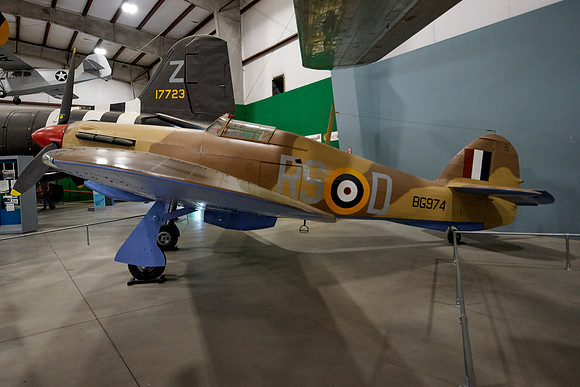
2025 0324 113
Hawker Hurricane Mk. IIB Trop.
The Hawker Hurricane was the first modern monoplane fighter flown by the Royal Air Force. Design work began as early as 1932, but the prototype did not take to the air until November 1935. In addition to being the first British fighter to have both a single wing and retractable landing gear the Hurricane also introduced much heavier firepower with a total of eight machine guns mounted in its wings. After initial testing the RAF placed a huge order for 600 Hurricanes. It was this model, the Hurricane Mk. I, that bore the brunt of the Battle of Britain during the summer of 1940. Late in 1940 the Hurricane Mk. II appeared in RAF service. This version of the fighter was slightly larger and had a more powerful version of the Merlin engine. The Mk. II became the most produced version of the Hurricane with 8,000 built in England and Canada.
Wingspan40 ft
Length32 ft
Height13 ft 1 in.
Weight8,050 lbs (loaded)
Maximum Speed342 MPH
Service Ceiling36,300 ft
Range470 miles
EngineOne Rolls-Royce Merlin XX 12 cylinder with 1,280 horsepower
Crew1
ManufacturerHawker
MarkingsRoyal Air Force, No. 33 Squadron, North Africa, 1942
Serial Number“BG974”
DesignationHurricane Mk. IIB Trop.
above:
Taylorcraft TG-6
Early in World War II, the Army Air Forces recognized a requirement for a simplified training glider for beginning instruction of pilots who would go on to fly troop gliders in combat. The quickest solution was to modify existing civilian light aircraft designs to serve as gliders. The Piper, Aeronca, and Taylorcraft companies each modified one of their designs for Army use. The Taylorcraft offering was designated as TG-6 and was modified from the company’s L-2 Grasshopper. Modifications included a redesigned nose that replaced the engine with a third seat for an instructor, slightly enlarged tail, and redesigned landing gear. The modifications for the prototype were done in only nine days. A total of 250 were built f