2025 0324 071
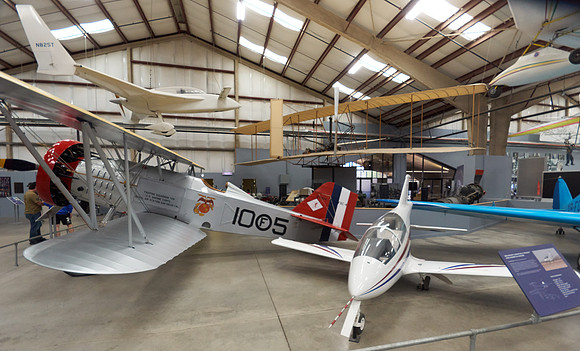
Curtiss F6C-4 Hawk
The Curtiss F6C Hawk was an interwar Navy and Marine Corps single engine, single seat fighter based on the Army’s Curtiss P-6 Hawk. Like the P-6 the early versions of the F6C were powered by a Curtiss V-12 liquid cooled engine. The aircraft was armed with two .30 caliber machine guns and could carry a small bomb load. Due to the aircraft’s sturdy design and construction, the F6C became one of the Navy’s first aircraft capable of dive bombing at a steep angle.
A prototype of an updated version of the Hawk, designated F6C-4, was delivered to the Navy in 1927. The Navy had decided that air cooled radials were easier to maintain than liquid cooled inline engines while at sea, so the F6C-4 was designed and built with a Pratt & Whitney R-1340. The Navy ordered thirty-one F6C-4s and assigned them to Fighter Squadron 2 (VF-2B) aboard the USS Lexington. The Navy retired them from front line service in 1930, though the Marine Corps continued to use them until late 1932. Most of the Marine F6C-4s were assigned to Marine Fighter Squadron 10 (VF-10M) at Naval Air Station San Diego.
On loan from the National Museum of the Marine Corps.
Wingspan37 ft 6 in.
Length22 ft 6 in.
Height10 ft 11 in.
Weight2,785 pounds (loaded)
Maximum Speed155 MPH
Service Ceiling22,900 ft
Range360 miles
EngineOne Pratt & Whitney R-1340 radial, 410 horsepower
Crew1
ManufacturerCurtiss Aircraft Company
MarkingsMarine Fighter Squadron 10 (VF-10M), Naval Air Station San Diego, 1931
DesignationF6C-4
Serial NumberA-7404
Bede Aircraft Company BD-5J “Microjet”
The Bede BD-5 was developed as a single-seat pusher-prop homebuilt aircraft in the early 1970s. The BD-5 proved to be a challenge both to build and to fly. While many kits were sold, they often proved to be beyond the abilities of most homebuilders to complete and, even when finished, the tiny aircraft require a very competent pilot to fly them safely. In 1973, Bede Aircraft introduced a jet-powered version the