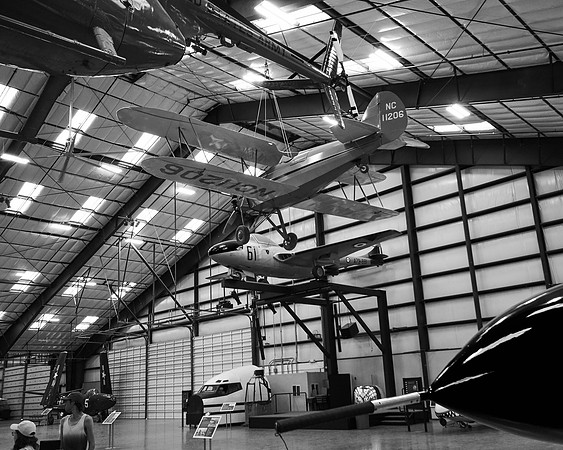
2025 0324 064
Boeing A75N1 (PT-17) Stearman Kadet
One of the most famous aircraft of World War II, the PT-17 was developed as a private venture of the Stearman Aircraft Company. Development of the aircraft began in 1934, with the first Army order for the plane coming in 1936. Stearman was actually a division of the Boeing company and the aircraft was eventually sold under the Boeing name. Every pilot in the Army Air Force during World War II flew a PT-17 at some time during their training. Thousands of them were built for the American military and for export. A great many of these found their way into civilian hands at the close of the war. Civilian uses included pilot training, aerial crop spraying, pleasure flying, and air show performances. The Stearman remains a popular aircraft at airshows today.
Wingspan32 ft 2 in.
Length24 ft
Height9 ft 2 in.
Weight2,717 lbs (loaded)
Maximum Speed124 MPH at sea level
Service Ceiling11,200 ft
Range505 miles
EngineOne Continental R670-5 piston radial with 220 horsepower
Crew2
ManufacturerBoeing
MarkingsUnited States Army Air Forces, 1941
DesignationA75N1
RegistrationN48576
Serial Number41-8882
De Havilland T.35 Vampire
The Vampire jet fighter was designed for the British Royal Air Force. Design work began in mid 1942 and the first prototype flew in September 1943. The Vampire was the second jet fighter to enter service with the RAF although it did not see combat in World War II. The Vampire remained in RAF service as a fighter-bomber until the end of the 1950s. The two-seat trainer version was used until 1966. The aircraft was also adopted by more than thirty other air forces around the world with the last of them leaving the Rhodesian Air Force in the early 1980s.
The Royal Australian Air Force was one of the largest users of the Vampire with nearly 200 aircraft being built in Australia by de Havilland’s Australian branch. The two seat T.35s were delivered between 1952 and 1954. They served in the RAAF unti